
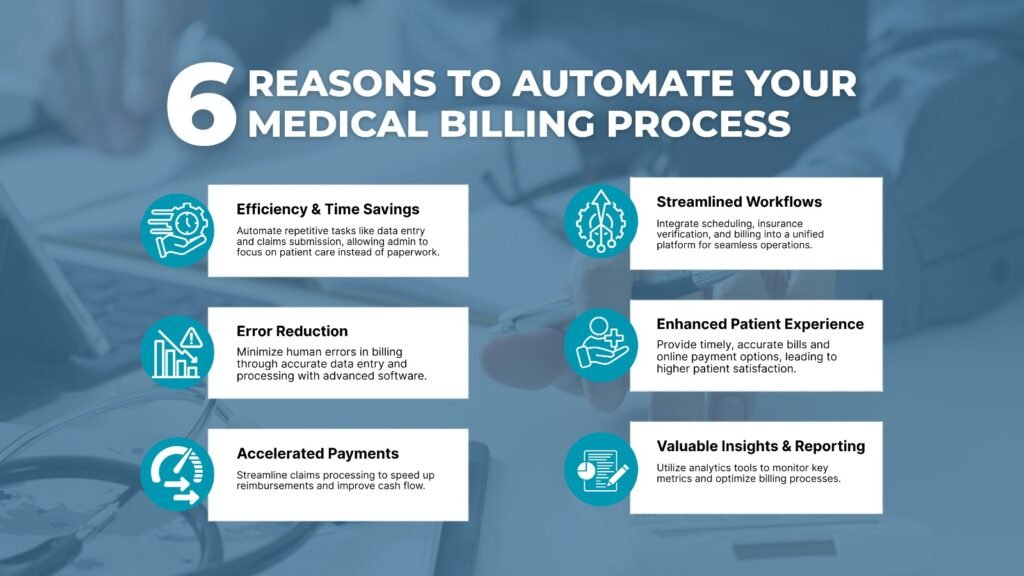
Reasons to Automate Your Medical Billing Process
Medical billing is an essential part of every healthcare practice, but manual billing processes can be time-consuming, complex, and prone to errors. From entering patient information to submitting claims and tracking payments, administrative tasks can take valuable time away from your team.
Automating your medical billing process can simplify these tasks, improve accuracy, accelerate payments, and create a more efficient experience for both staff and patients.
Here are some key reasons why healthcare practices should consider automating their medical billing operations.
1. Efficiency & Time Savings
Medical billing involves several repetitive tasks, including data entry, insurance verification, claim submission, payment posting, and follow-ups. Automation can handle many of these routine processes quickly and consistently.
By reducing manual work, administrative teams can spend less time on paperwork and more time focusing on patient support and other important responsibilities.
2. Error Reduction
Even small errors in patient information, insurance details, billing codes, or claim submissions can result in rejected or delayed claims.
Automated billing software helps reduce human errors by capturing and processing information accurately. Built-in checks and automated workflows can also identify potential issues before claims are submitted, helping practices avoid unnecessary delays and rework.
3. Accelerated Payments
Delayed reimbursements can have a direct impact on a healthcare practice’s cash flow. Manual claims processing and follow-ups can slow down the payment cycle.
Automation helps streamline claim submission, payment tracking, and follow-up processes. Faster and more accurate claims can help practices receive reimbursements sooner and maintain healthier cash flow.
4. Streamlined Workflows
A modern medical billing system can connect multiple administrative processes within a unified platform.
Scheduling, patient registration, insurance verification, billing, claims management, and payment processing can work together seamlessly. This reduces the need to move information between different systems and creates a smoother workflow for the entire practice.
5. Enhanced Patient Experience
Patients expect healthcare services to be convenient, transparent, and easy to manage. Billing is an important part of that experience.
Automated systems can help provide timely and accurate bills while offering convenient options such as online payments and digital billing communication. A simpler billing experience can reduce confusion and improve overall patient satisfaction.
6. Valuable Insights & Reporting
Automation does more than process bills—it can also provide valuable information about your practice’s financial performance.
Analytics and reporting tools can help track important metrics such as claim rejection rates, outstanding payments, reimbursement timelines, and revenue trends. These insights allow practice managers to identify bottlenecks, make informed decisions, and continuously improve billing operations.
The Bottom Line
Automating your medical billing process can transform the way your healthcare practice manages its financial operations. By reducing repetitive work, minimizing errors, accelerating reimbursements, streamlining workflows, and improving the patient billing experience, automation can help your team operate more efficiently.
With the right medical billing technology, practices can spend less time managing paperwork and more time focusing on what matters most—providing quality patient care.
Ready to Modernize Your Medical Billing?
Investing in medical billing automation is not simply about replacing manual tasks. It is about creating a more accurate, efficient, transparent, and scalable billing process that benefits your practice, your staff, and your patients.