
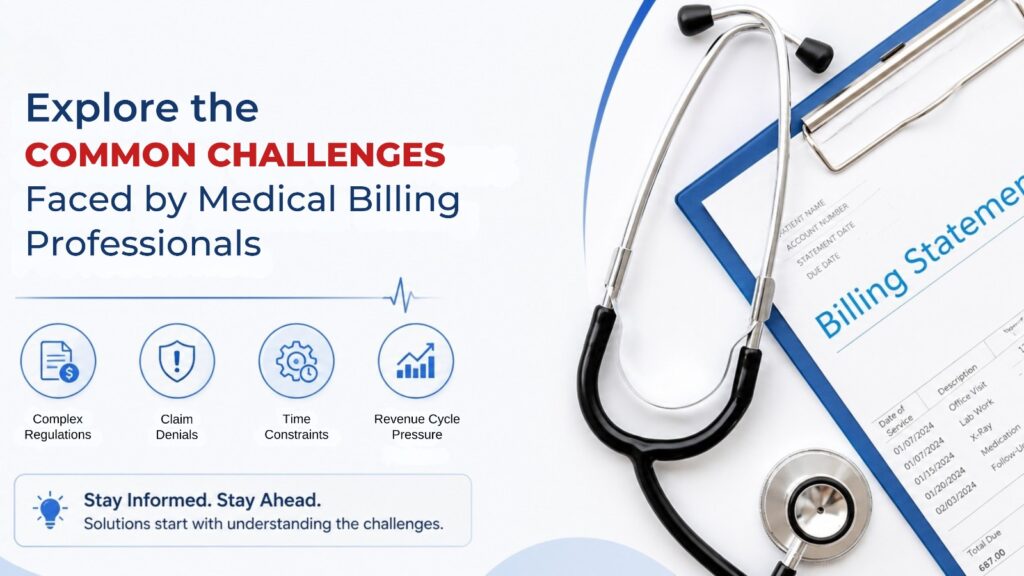
Explore the Common Challenges Faced by Medical Billing Professionals
Medical billing is the backbone of the healthcare revenue cycle. It ensures that healthcare providers receive accurate and timely reimbursement for the services they deliver. However, medical billing professionals face numerous challenges every day, from navigating changing regulations to managing claim denials. Understanding these obstacles is the first step toward improving efficiency and maximizing revenue.
Why Medical Billing Matters
Medical billing is more than just submitting insurance claims. It involves verifying patient information, assigning accurate medical codes, ensuring compliance with payer requirements, and following up on unpaid claims. Even a minor error can result in delayed payments or denied claims, affecting the financial health of a healthcare organization.
Common Challenges Faced by Medical Billing Professionals
1. Complex Healthcare Regulations
Healthcare regulations and insurance policies are constantly evolving. Medical billing professionals must stay up to date with changing coding guidelines, payer rules, and compliance requirements. Failure to follow these standards can lead to claim rejections, audits, or financial penalties.
2. Claim Denials
Claim denials remain one of the biggest challenges in medical billing. Incorrect patient information, coding errors, missing documentation, or failure to meet payer requirements can all result in denied claims. Efficient denial management and timely appeals are essential to recovering lost revenue.
3. Time Constraints
Medical billing teams often work under tight deadlines while managing large volumes of claims. Balancing accuracy with speed can be difficult, especially in busy healthcare practices. Streamlined workflows and automation can help reduce administrative burdens.
4. Revenue Cycle Pressure
Delayed reimbursements, unpaid claims, and billing inaccuracies can negatively impact the entire revenue cycle. Medical billing professionals must continuously monitor accounts receivable, resolve payment issues, and ensure providers receive timely compensation.
How to Overcome These Challenges
Healthcare organizations can improve billing performance by adopting the following strategies:
- Invest in continuous training for billing and coding staff.
- Use advanced medical billing software with automation features.
- Perform regular coding and documentation audits.
- Verify patient eligibility before services are provided.
- Track denied claims and identify recurring issues.
- Stay informed about payer policy updates and industry regulations.
- The Role of Technology
Modern medical billing software and AI-powered solutions are transforming healthcare administration. Automation helps reduce manual errors, speeds up claim processing, improves coding accuracy, and provides valuable insights through reporting and analytics. By embracing technology, healthcare organizations can increase operational efficiency and improve financial performance.
Final Thoughts
Medical billing professionals play a critical role in ensuring the financial success of healthcare providers. Although challenges such as complex regulations, claim denials, time constraints, and revenue cycle pressures are common, they can be effectively managed with the right knowledge, technology, and best practices.
Stay informed. Stay ahead. By understanding these common medical billing challenges and implementing proactive solutions, healthcare organizations can improve claim accuracy, accelerate reimbursements, and build a stronger, more efficient revenue cycle.